

Built to Ride
Bend Magazine writer Daniel O’Neil features the AdvenChair wheelchair that thinks its a mountain bike in his Sept/Oct 2025 article “Built to Ride—Custom bikes are a growing industry.” Downhill, cross-country, touring, road, gravel—the high desert offers every option a cyclist could ask for. It follows, then, that the area is also home to a core group of custom bike builders who are pushing bicycle engineering and production past any preconceived boundaries, while also maintaining the spirit of elation and freedom that cycling can provide.

Bend Magazine September-October 2025 Issue
Built to Ride
By Daniel O’Neil for Bend Magazine
Custom bikes are a growing industry
Downhill, cross-country, touring, road, gravel—the high desert offers every option a cyclist could ask for. It follows, then, that the area is also home to a core group of custom bike builders who are pushing bicycle engineering and production past any preconceived boundaries, while also maintaining the spirit of elation and freedom that cycling can provide.

An Argonaut bike is built specifically for its rider.
photo by Mighty Creature
In the United States, about 20 million bikes are sold each year, generating a market revenue of $8 billion. Some 98% of these bikes are manufactured in Asia. This may seem like an unfair headwind for Central Oregon’s bike companies, but instead they use it to their advantage by providing a custom bike build experience.
As Central Oregon’s trail systems expand and more cyclists move to the area, the pack of custom bike companies is gaining speed. Their market, from local to international cyclists, is starting to take notice.
PURSUING PERFECTION
Argonaut Cycles designs and builds some of the world’s most customized road and gravel bikes, which start at $16,000. Founded by Ben Farver in 2007, today Argonaut rolls out 200 high-end bikes a year, all made by hand starting with raw sheets of carbon fiber. Design, product testing and fabrication all happen in Central Oregon.
For cyclists who have spent enough time in the saddle to become one with their bike, customization offers an opportunity to exploit the benefits of different bike-frame geometries and flex patterns. Rather than ride a bike designed for a predetermined style of riding, and a particular weight and height range, a custom bike fine tunes performance. places offer such a surreal yet delightful expanse of climates, altitudes, and, it turns out, attitudes.
For the love of it
Due to steeper prices, and the challenges of reaching a niche market, custom bike building is a small but strong segment in Central Oregon. Without the deeper financial resources of major bike brands, custom builders rely on commitment and stoke instead.
Bend-grown 21-year-old Ethan Eggert founded Arid Cycles after high school. Arid’s full-suspension mountain bike frames are modular, allowing for a rider to select customized options when building the frame. Still in the prototype phase, Eggert plans to open pre-orders this fall. He’s proud to have stayed in Bend to pursue his project. “The market for high-end is there, and it still has room to grow,” Eggert said. “We’re in a good place because we have what people are looking for that they can’t find at the other brands.”
Besides the technical merits, working with a custom builder offers real-life value, allowing rider and builder to develop a relationship like that between surfer and shaper. “You’re supporting someone who’s passionate about what they’re making,” said Max Keegan, who custom welds about three to five bike frames a year as part of his project, Mostly Forever. Frames sell for between $1,900 and $2,500. “It’s sort of the farm-to-table deal, a closer circle. I get the materials, I make a bike frame, and I give it to you—versus a bike frame made overseas, shipped to a distribution center and then shipped to a bike shop.”

Ethan Eggert founder of Arid Cycles
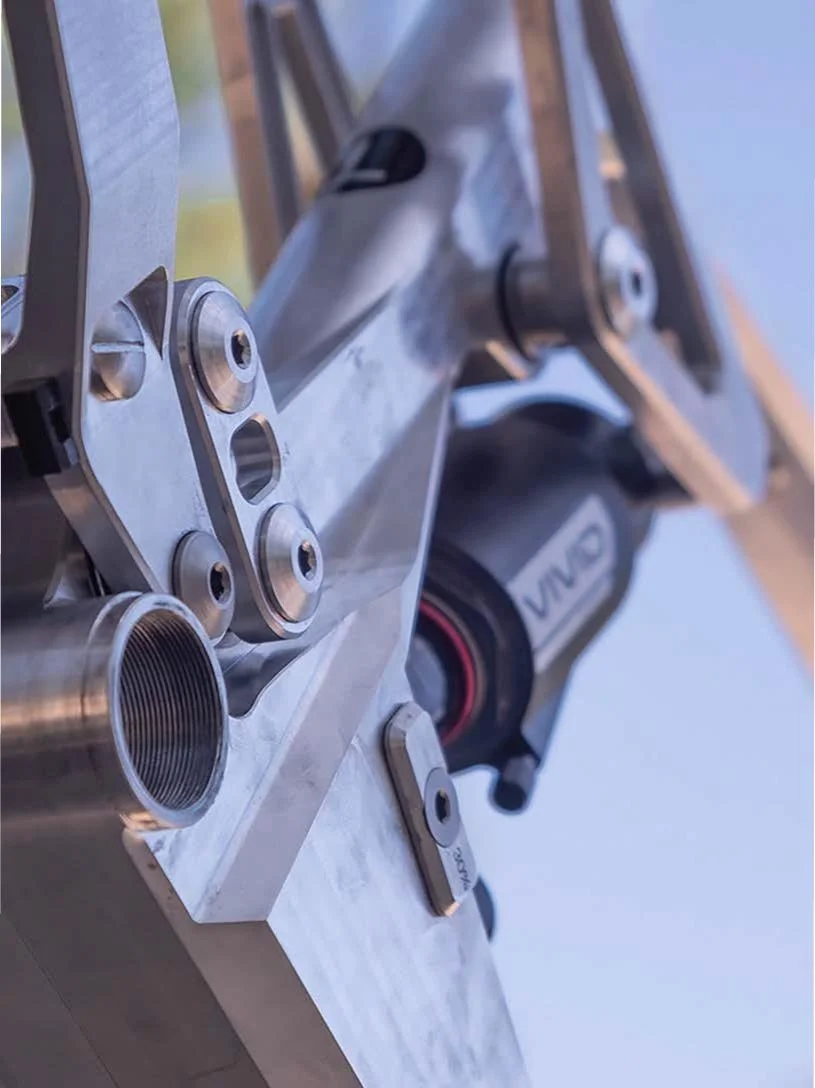
Arid Cycles custom frame
Cyclists from Bend and beyond are becoming aware of the incomparable custom-build options taking off in Central Oregon. “For those riders who have been on the other top-shelf bikes, there’s a growing segment of folks who are looking for something different, cooler and more progressive that separates their riding and puts it on the next level of what’s possible,” Argonaut’s Rudisill said. As far as cycling in Central Oregon goes, from its extensive trail options and routes to its emerging custom builds, nothing is impossible.
click to enlarge
Access for all

Geoff Babb, founder of AdvenChair
photo by Cody Reux
Rich in innovation and collaboration, Central Oregon does not limit itself. When Geoff Babb suffered a paralyzing stroke in 2005, he refused to give up his passion for trails. In response, Babb pursued an off-road wheelchair that could explore places like the Grand Canyon. Babb tested his first AdvenChair in 2016, and today his volunteer-run nonprofit provides all-access wheelchairs for people from age 6 to 96 who previously couldn’t get to places such as Smith Rock in a standard wheelchair.
An AdvenChair costs around $12,000, but Babb works with outdoor schools and tour operators in the United States and beyond to make the chairs themselves more accessible. “We’re allowing a whole range of people to be outside enjoying nature,” Babb said.
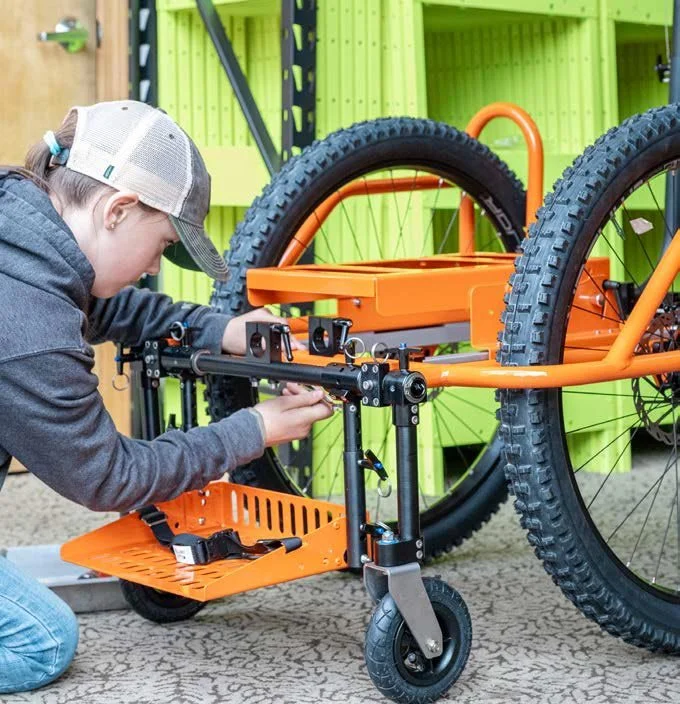
Each AdvenChair is made by hand
photo by Eleanor Moseman
Central Oregon’s strong sense of community and entrepreneurship provided the ideal environment for AdvenChair to get rolling. “Really important locally is just being in Central Oregon where there are so many small businesses, so many startups,” said Babb. “I really benefited from being in this incubator, in this small, very supportive group of companies.”

The AdvenChair is designed to go out of bounds.
The AdvenChair, created by Geoff Babb and Dale Neubaurer, is an all-terrain wheelchair designed to go off-road. In September 2016, almost eleven years after suffering a near-fatal brain-stem stroke, Geoff Babb sat in his modified wheelchair at the Bright Angel trailhead with his family and a group of friends. Given the path that he had traveled to reach that point, a wheelchair journey into the belly of the Grand Canyon didn’t seem far-fetched.

The AdvenChair, created by Geoff Babb and Dale Neubaurer, is an all-terrain wheelchair designed to go off-road.
BY CAM DAVIS
PHOTOS BY MICHELLE SIMMONS
In September 2016, almost eleven years after suffering a near-fatal brain-stem stroke, Geoff Babb sat in his modified wheelchair at the Bright Angel trailhead with his family and a group of friends. Given the path that he had traveled to reach that point, a wheelchair journey into the belly of the Grand Canyon didn’t seem far-fetched.
An avid backpacker, climber and mountain biker before his lifechanging stroke, Babb wasn’t content to surrender his outdoor lifestyle because of his limited mobility. Determined to get back into the wild places that inspired him, he soon realized that his enjoyment of the outdoors with friends was limited not so much by his legs, but the frailties of his wheelchair.
“Normal wheelchairs just can’t cut it in the wilderness,” said Babb. “To get off the beaten path, I needed something that was much more durable and versatile than anything out there. That’s how the AdvenChair was born.”
Babb, a fire ecologist for the BLM, began developing the all-terrain AdvenChair several years ago with the help of Dale Neubauer, a friend and helicopter mechanic. Together they created a human-powered vehicle with mountain bike tires, a detachable front wheel, a rear handle bar with dual disc brakes, and a harness that would allow a team of up to four people to push, pull and guide Babb up and down rugged trails, as well as over sand and snow.
“What drove me to work with Geoff was his incredible perseverance, optimism and positive drive,” said Neubauer. “When you spend time around someone like that, the last thing you’d want to do is hold him back.”
Initially, Babb’s stroke therapy included sit-skiing with Oregon Adaptive Sports and visits to Healing Reins Therapeutic Riding Center, which gave him the idea to trek with friends into the Grand Canyon via pack mule. But when the wait for a permit and other logistics got in the way of a trip in September of 2016, he decided to put his AdvenChair to the test instead.
Despite surviving rugged trails at Mount Bachelor and Smith Rock State Park, as well as at Mount Rainier, Crater Lake and Glacier national parks, the AdvenChair ultimately succumbed to a broken axle sheath two miles down the Bright Angel Trail. “The pounding of the wheels over dozens of water bars was just too much,” explained Babb.
The break sent Babb and his team back to the drawing board to strengthen the AdvenChair.

“The structural failure of the axle assembly allowed us to start with a clean slate,” said Neubauer. “Geoff came up with the idea of blending the attributes of a sit-ski with high-grade aluminum mountain bike components, including beefier twenty-seven-and-a-half inch wheels, that led us to an entirely new hybrid design.”
After receiving encouragement at Bend’s Venture Out Conference in October of 2017, Babb was preparing an IndieGoGo campaign to help produce prototypes of Version 2.0, when he encountered a significant bump in the road. On November 10, 2017, he had a second stroke—twelve years to the day after his first one.
“The chances of surviving a brain-stem stroke are about 10 percent,” said Geoff’s wife Yvonne. “I knew getting him back from another one at age 60 would be pretty miraculous. But he looked at me from his hospital bed the next day and confidently murmured, ‘Not our first rodeo’.”
Despite doctor’s predictions, Babb relearned how to swallow and eat solid food all over again, and emerged more determined than ever to bring the AdvenChair 2.0 to reality, not just for himself, but for the nearly 15 million people nationwide suffering from limited mobility, and highly limiting wheelchairs.
Oregon Adaptive Sports Executive Director, Pat Addabbo, sees tremendous potential on a global scale. “As a program provider, the things I look for are adjustability for different sizes and abilities of people, ease of assistance by staff/volunteers and durability,” he says. “The AdvenChair fits all of these. It will surely fill a need in the adaptive recreation industry.”
Babb’s fellow Oregon Adaptive Sports skier Kirk Petersen, who is paralyzed from the waist down, is anxious to test the new chair.
“The chair is going to do wonders for getting people like myself to remote places,” said Petersen. “We don’t want to be stuck in the house watching TV. We want to be doing the same things everyone else wants to be doing outside. We just need a little help.”
Perhaps not surprisingly, Babb chose November 10, 2018 as the day to launch his fundraising campaign to help build and test several prototypes. With funding through his website, his goal is to begin selling chairs in 2019, and ultimately, to see them in use throughout the country, so people can share their stories online.
“Having access to nature and solitude does wonders for the mind and body,” said Babb. “Whether venturing to the bottom of the Grand Canyon or not, we hope to provide some very rewarding journeys.”