

Strokecast Episode 063—Stroke Survivor Designs Off Road Wheelchair
A few weeks ago, we heard from Carol-Ann Nelson from Destination Rehab about the PT work she does in Bend, OR, helping folks with disabilities from around the world spend a week doing rehab and enjoying all the beauty that Central Oregon in the northwest United States has to offer. After we finished, Carol-Ann told me about Geoff Babb, a fellow Bend, OR, resident who had his own project.

Geoff Babb, inventor of the AdvenChair

“The wild requires that we learn the terrain, nod to all the plants and animals and birds, ford the streams and cross the ridges, and tell a good story when we get back home.”
—Gary Snyder
A few weeks ago, we heard from Carol-Ann Nelson from Destination Rehab about the PT work she does in Bend, OR, helping folks with disabilities from around the world spend a week doing rehab and enjoying all the beauty that Central Oregon in the northwest United States has to offer.
You can check out http://strokecast.com/destinationrehab to learn more about a Rehab Vacation or listen to that episode.
After we finished, Carol-Ann told me about Geoff Babb, a fellow Bend, OR, resident who had his own project.
“Whether it’s AdvenChair or just being out on their own I want to encourage people to get out and tell their own stories and feel empowered by their experiences outside. — Geoff Babb, @TheAdvenChair #stroke #wheelchair”
Geoff Babb is a 2-time stroke survivor who loves the outdoors. After he got back to Bend following his work on Hurricane Katrina relief efforts, he had a brainstem stroke. After that first stroke, he discovered standard wheel chairs are not compatible with hiking trails. They’re barely compatible with city sidewalks. So he decided to invent his own and thus, the AdvenChair project was born.
Timing
Timing is one of the amazing things about the story.
Geoff had been helping out in the New Orleans area in the aftermath of Hurricane Katrina. It was right after he got back to his home in Oregon that he had his stroke. Had it happened while he was still in New Orleans, his recovery would likely have been much more challenging, considering how strained the infrastructure was at the time.
This actually raises another interesting point for discussion in the future. As folks survive uninjured from natural disasters like Katrina or Maria, they are still susceptible to the same medical challenges folks in the rest of the country face — stroke, heart attack, car crashes, etc.
How does the limited or over-stretched post-disaster infrastructure impact their recovery? And if someone dies from a stroke due to limited availability of care a week or month after a disaster do they get counted among the disaster’s victims? This opens up all sorts of questions of equality, social justice, and simple fairness.
The first AdvenChair failed early in a hike instead of later. The timing was also fortuitous, avoiding an expensive, time consuming, and risky rescue.
And finally, Geoff’s second stroke was 12 years to the day of his first one. It’s amazing how those timing things all come together.
“My days in rehab would start out with my attitude of Well, I'm going to work. This is my job right now.”
—Geoff Babb, @TheAdvenChair #stroke #wheelchair
Developing the AdvenChair
Geoff has a lot more details on the process of designing this chair on his website, and I’d encourage you to check it out (and contribute if you can).
There are a few things in particular that come up in the conversation.
Geoff and his team ultimately had to start from scratch with the concept, rather than modifying an existing chair.
I know very little about the history of wheel chairs, but it seems to me, they were first built as a chair that could then move, rather than as a method of transportation that could then allow a person with disabilities to be seated.
Looking back at the historical wheelchairs we see on TV and period movies, they’re almost dollies for moving a person, almost as though the person is a type of cargo. It seems they evolved from there.
That sort of approach impacts your goals when you design something and also offers some insight into how designers viewed people with disabilities and the people who assist them at the time.
I should reiterate that this is my analysis, not Geoff’s.
“The big thing... was that we realized a standard wheelchair or modifying wheelchair was not going to do it. We needed to start from the ground up & make it more like a mountain bike.”
—Geoff Babb, @TheAdvenChair #stroke
Geoff and his team started pulling together ideas that aren’t based in the dining room chair metaphor.
They looked first at vehicles already optimized for off road use — skis for wheelchair users and mountain bikes for ableds. Then they grew the plan from there.
Instead of focusing on pushing the chair, the looked at Pulk Sleds used by arctic explorers and other folks to develop a method for pulling it.
And they made sure it could be self-propelled and work in environments already friendly to traditional wheelchairs.
“So what we like to say is that AdvenChairing is a team sport.”
—Geoff Babb, @TheAdvenChair #stroke #wheelchair
Bio
“Whether it's AdvenChair or just being out on their own I want to encourage people to get out and tell their own stories and feel empowered by their experiences outside.”
—Geoff Babb, @TheAdvenChair #stroke #wheelchair
Geoff Babb’s first of two strokes abruptly pushed him into the world of disability. Today Geoff is the AdvenChairman of the Onward Project, which seeks to inspire, encourage, and enable people of all abilities to have active outdoor adventures.

Geoff Babb
Geoff is active in the disabled and adaptive community in Central Oregon. He is currently on the board of Oregon Adaptive Sports and the Advisory Council of Stroke Awareness Oregon. Previously, he served on the board of Healing Reigns Therapeutic Riding Center and the City of Bend Accessibility Advisory Committee. Through these experiences, Geoff has an in-depth understanding of the outdoor adventure opportunities available for people with mobility challenges, be it by horse, ski, or wheels. There are many possible ways for stroke survivors to be outdoors.
Before his first stroke, he was an active outdoor enthusiast who enjoyed mountain biking, skiing, and hiking with his wife and twin sons, and he enjoyed a long career in wildland fire management.
Geoff’s life has been an odyssey and three significant life events have emerged as important opportunities:
Surviving his first brain-stem stroke in 2005. This changed his relationship to the world in general and the natural world in particular. No longer was he able to work, hike, bike, ski, and enjoy the outdoors as he had before. So, with help from friends and family, he developed a modified wheelchair that allowed him to go places where he could still have a meaningful connection with nature.
In 2016, he and his team attempted to go to the bottom of the Grand Canyon when his wheelchair broke an axle. While they didn’t achieve their goal, this experience inspired an opportunity to design a better chair, one more durable for off-road travel.
Twelve years to the day from the first stroke, in 2017 Geoff survived a second brain-stem stroke. This one helped him focus his energy to complete what is now the AdvenChair.
Because of these opportunities, Geoff’s dream is to help people experience the outdoors and wild places using the AdvenChair, rolling boldly where no chair has gone before.
At one point several month afterwards I realized it I didn't want to think of myself as a patient anymore, but I was definitely as a survivor.
—Geoff Babb, @TheAdvenChair #stroke #wheelchair
Hack of the Week
Geoff recommends a cellphone that works with a stylus. Phones optimized for this technology have options that go beyond just using a generic stylus. They include special software and native support for digital ink.
The Samsung Galaxy Note product line is one fantastic option. I use an LG Stylo 4, which is less expensive but slower and older.
The advantage of a stylus is that you can get more precise control when writing emails and messages. You can also send messages in handwriting or draw pictures and do lots of cool things. If you have the strength to hold the phone with one hand while tapping with another this is great.
Now as I think about it, if I was left handed, I might use my stylus more. My current phone challenge is that I have to use it entirely in my right hand, and I have trouble reaching the left side of the screen with my thumb, resulting in more typos. My left hand isn’t strong enough to hold my phone yet, but it might be strong enough to hold a stylus.
So I guess one of my next projects ought to be figuring out if I can teach myself to write or tap on a phone screen with my affected hand. It’s my non-dominant hand so this would have been tough before the stroke, but now I get to deal with proprioception challenges, tone, spasticity, and weakness.
Sounds like a good therapy goal to me.
Thanks for the idea, Geoff!
I knew from my previous stroke there was lots information from lots of doctors and I wanted to keep track of that. So I had my son bring in a good size whiteboard and we just kept recording everything.
—Geoff Babb, @TheAdvenChair…

Smith Rock—proving ground for local inventor's all-terrain wheelchair.
Geoff Babb’s first ride in his wheelchair to the park back in 2006 was not pretty. He promptly did a face plant as the front wheels got stuck in a crack in the sidewalk. But while a near-fatal brain stem stroke left him with only limited use of one hand, he soon found his inflexible wheelchair to be the biggest obstacle to having fun in his beloved outdoors again. He set out to do something about it.

The AdvenChair in full test mode at Smith Rock State Park
BY SMITHROCK.COM
PHOTOS BY MICHELLE SIMMONS
Geoff Babb’s first ride in his wheelchair to the park back in 2006 was not pretty. He promptly did a face plant as the front wheels got stuck in a crack in the sidewalk. But while a near-fatal brain stem stroke left him with only limited use of one hand, he soon found his inflexible wheelchair to be the biggest obstacle to having fun in his beloved outdoors again. He set out to do something about it.
Over the last 13 years Geoff and his team, including his dedicated wife Yvonne, helicopter mechanic Dale Neubauer, and CAD designer Jack Arnold, designed, tested, and tinkered to create a totally new human-powered off-road chair that thinks it’s a mountain bike—the AdvenChair. All this, in spite of a second stroke 12 years to the day after the first one.
GEOFF BABB, CREATOR OF THE ADVENCHAIR
“While the (second) stroke forced me to learn how to swallow, eat solid foods, and use my right hand all over again, it heightened my determination to bring the “AdvenChair 2.0” to reality. Not just for me, but for the millions of people around the world with limited mobility, and even more limited one-dimensional chairs.”
GEOFF BABB
Geoff was back at Smith Rock recently with the latest iteration of the AdvenChair to test once again, as the prototype gets refined through the Spring 2019, with a limited first production run based on funding scheduled for Fall 2019. He shared his Journal entry from the day for us to share with you.
AdvenChairing is a team sport.
By Geoff Babb
Photos by Michelle Simmons, The Suitcase Studio
My wife, Yvonne often refers to the AdvenChair as the “community chair” because so many people are involved with it, whether designing it, telling the story, or on the trail, where it takes a team to push, pull, and/or maneuver the chair. This was the case last week on a hike at Smith Rock State Park.
Our timing was perfect as we set a date a week in advance for a photoshoot of the newly powder coated AdvenChair to have high quality pictures to use on the website. With temps in the 50’s and blue skies, matched with stunning rock formations, conditions couldn’t have been much better.
Checking out the front wheel. Click to enlarge.
Photographer Michelle Simmons had a list of shots in mind – moving on the trail, people talking, close ups of the chair, and various group shots, and designer Jack Arnold wanted to watch how the chair performed, particularly the front wheel.
In the parking lot several people helped me transfer out of the van and into the AdvenChair while others readied the straps, poles, and shoulder harness needed for pulling.
Soon we were headed down the steep trail into the Crooked River Canyon. Amy Kazmier used the disc brakes to easily control my speed, but just in case, Dave Green and Kirk Metzger followed with nylon straps attached to the chair should she need help.
Amy Kazmier is on the disc brakes to safely descend into the park, with Dave Green and Kirk Metzger as backup on nylon straps and Brian Tandy on lead.
With her two-year-old daughter Addison on her back Danielle Cochran pushed me across the footbridge at the Crooked River. This was Danielle’s first outing with us, but she was already a valued team member after she and her husband Joe had donated coffee through their business Smith Rock Coffee Roasters to the Indiegogo fundraising campaign.
As Brian Tandy pulled me with two fiberglass poles attached to a shoulder/waist harness, the team easily moved me through rocky spots and across smooth boardwalks before really testing the system. Michelle asked for a photo near the water, so the team guided me about 50 feet down a log and earth staircase to a small beach. With a combination of teamwork, strength, and finesse I was quickly back up the stairs and onto the trail.
Moving through rocky spaces. Click to enlarge.
Heading down the stairs to the beach. Click to enlarge.
Heading across the boardwalk to the beach. Click to enlarge.
Hanging out on the beach. Click to enlarge.
At Smith Rock descending into the canyon from the parking lot is optional. From the bottom though, the climb out is mandatory; but three pullers and a pusher (with some rest breaks thrown in) quickly pulled me the 200 yards to the top.
Headed up the hill out of the canyon.
Around a picnic table we debriefed with an AAR – an “After Action Review” in military and firefighting parlance, but in this case, I’ll coin the term “After AdvenChair Review” – to discuss the day.
Everyone was impressed with how easily the AdvenChair rolls and how well the weight is balanced. Jack shared his ideas on upgrades to strengthen the front wheel and to improve the footrest and steering tubes. Through the test, AAR, refine cycle we’ll continue to improve the AdvenChair.
At the “After AdvenChair Review”
And a fine day was had by all!
With teamwork Michelle was able to get some good shots for the website, Jack got important feedback on the design, new people were able to experience the AdvenChair, and we all enjoyed a stellar January day.
Thanks Geoff for sharing your Journal entry with us and for all you are doing to help so many others with mobility issues get off the beaten path!

The AdvenChair is designed to go out of bounds.
The AdvenChair, created by Geoff Babb and Dale Neubaurer, is an all-terrain wheelchair designed to go off-road. In September 2016, almost eleven years after suffering a near-fatal brain-stem stroke, Geoff Babb sat in his modified wheelchair at the Bright Angel trailhead with his family and a group of friends. Given the path that he had traveled to reach that point, a wheelchair journey into the belly of the Grand Canyon didn’t seem far-fetched.

The AdvenChair, created by Geoff Babb and Dale Neubaurer, is an all-terrain wheelchair designed to go off-road.
BY CAM DAVIS
PHOTOS BY MICHELLE SIMMONS
In September 2016, almost eleven years after suffering a near-fatal brain-stem stroke, Geoff Babb sat in his modified wheelchair at the Bright Angel trailhead with his family and a group of friends. Given the path that he had traveled to reach that point, a wheelchair journey into the belly of the Grand Canyon didn’t seem far-fetched.
An avid backpacker, climber and mountain biker before his lifechanging stroke, Babb wasn’t content to surrender his outdoor lifestyle because of his limited mobility. Determined to get back into the wild places that inspired him, he soon realized that his enjoyment of the outdoors with friends was limited not so much by his legs, but the frailties of his wheelchair.
“Normal wheelchairs just can’t cut it in the wilderness,” said Babb. “To get off the beaten path, I needed something that was much more durable and versatile than anything out there. That’s how the AdvenChair was born.”
Babb, a fire ecologist for the BLM, began developing the all-terrain AdvenChair several years ago with the help of Dale Neubauer, a friend and helicopter mechanic. Together they created a human-powered vehicle with mountain bike tires, a detachable front wheel, a rear handle bar with dual disc brakes, and a harness that would allow a team of up to four people to push, pull and guide Babb up and down rugged trails, as well as over sand and snow.
“What drove me to work with Geoff was his incredible perseverance, optimism and positive drive,” said Neubauer. “When you spend time around someone like that, the last thing you’d want to do is hold him back.”
Initially, Babb’s stroke therapy included sit-skiing with Oregon Adaptive Sports and visits to Healing Reins Therapeutic Riding Center, which gave him the idea to trek with friends into the Grand Canyon via pack mule. But when the wait for a permit and other logistics got in the way of a trip in September of 2016, he decided to put his AdvenChair to the test instead.
Despite surviving rugged trails at Mount Bachelor and Smith Rock State Park, as well as at Mount Rainier, Crater Lake and Glacier national parks, the AdvenChair ultimately succumbed to a broken axle sheath two miles down the Bright Angel Trail. “The pounding of the wheels over dozens of water bars was just too much,” explained Babb.
The break sent Babb and his team back to the drawing board to strengthen the AdvenChair.

“The structural failure of the axle assembly allowed us to start with a clean slate,” said Neubauer. “Geoff came up with the idea of blending the attributes of a sit-ski with high-grade aluminum mountain bike components, including beefier twenty-seven-and-a-half inch wheels, that led us to an entirely new hybrid design.”
After receiving encouragement at Bend’s Venture Out Conference in October of 2017, Babb was preparing an IndieGoGo campaign to help produce prototypes of Version 2.0, when he encountered a significant bump in the road. On November 10, 2017, he had a second stroke—twelve years to the day after his first one.
“The chances of surviving a brain-stem stroke are about 10 percent,” said Geoff’s wife Yvonne. “I knew getting him back from another one at age 60 would be pretty miraculous. But he looked at me from his hospital bed the next day and confidently murmured, ‘Not our first rodeo’.”
Despite doctor’s predictions, Babb relearned how to swallow and eat solid food all over again, and emerged more determined than ever to bring the AdvenChair 2.0 to reality, not just for himself, but for the nearly 15 million people nationwide suffering from limited mobility, and highly limiting wheelchairs.
Oregon Adaptive Sports Executive Director, Pat Addabbo, sees tremendous potential on a global scale. “As a program provider, the things I look for are adjustability for different sizes and abilities of people, ease of assistance by staff/volunteers and durability,” he says. “The AdvenChair fits all of these. It will surely fill a need in the adaptive recreation industry.”
Babb’s fellow Oregon Adaptive Sports skier Kirk Petersen, who is paralyzed from the waist down, is anxious to test the new chair.
“The chair is going to do wonders for getting people like myself to remote places,” said Petersen. “We don’t want to be stuck in the house watching TV. We want to be doing the same things everyone else wants to be doing outside. We just need a little help.”
Perhaps not surprisingly, Babb chose November 10, 2018 as the day to launch his fundraising campaign to help build and test several prototypes. With funding through his website, his goal is to begin selling chairs in 2019, and ultimately, to see them in use throughout the country, so people can share their stories online.
“Having access to nature and solitude does wonders for the mind and body,” said Babb. “Whether venturing to the bottom of the Grand Canyon or not, we hope to provide some very rewarding journeys.”

Revolutionary all-terrain wheelchair passes first trail test with flying colors.
The AdvenChair, a new all-terrain wheelchair developed entirely in Bend, Oregon, left its first tire tracks on local trails this month. Now, the company founded by fire ecologist Geoff Babb faces the challenge of making the product gain traction with the millions of people throughout the country who use wheelchairs, and are typically left stranded at the trailhead when friends and family want to go for a hike.
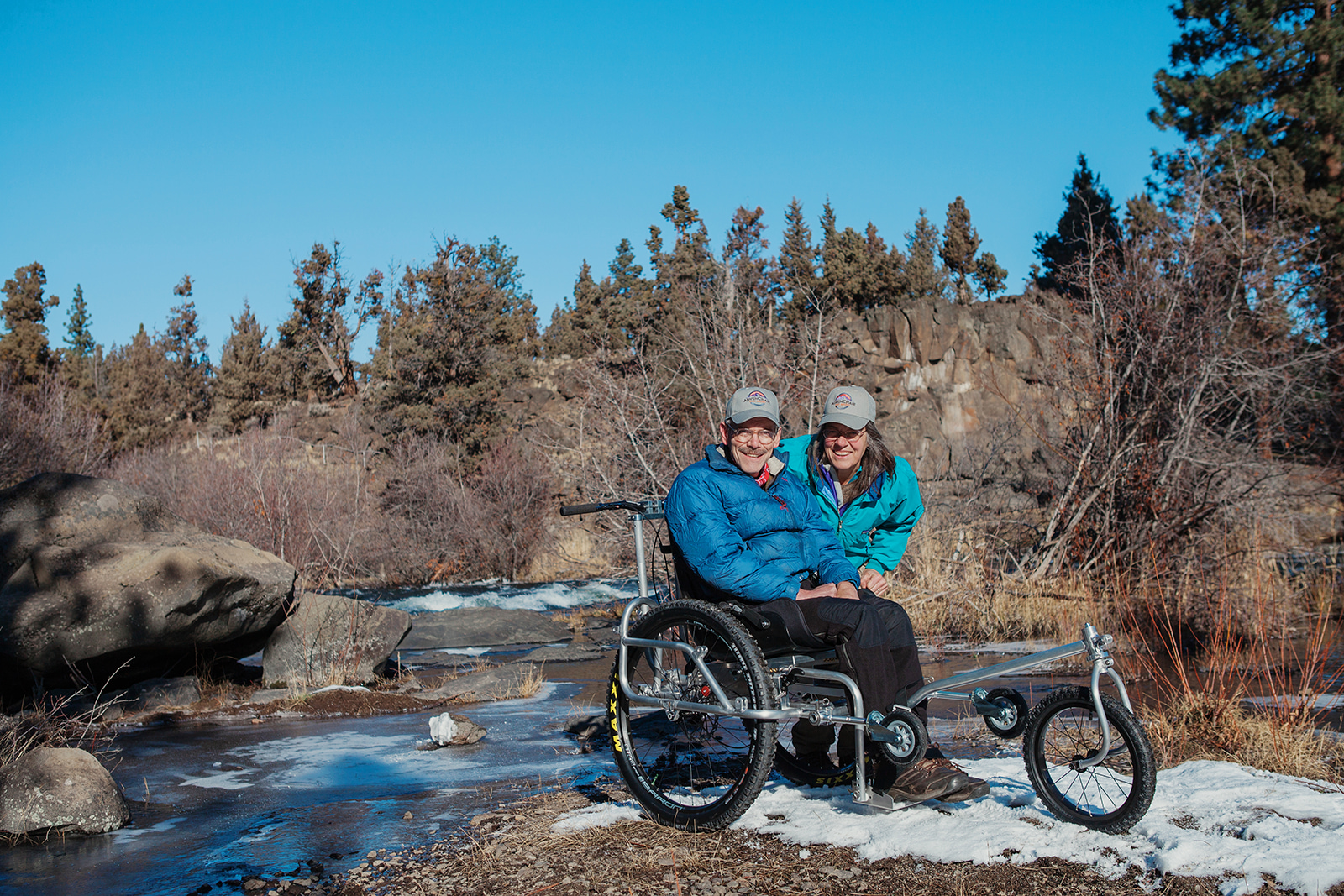
Geoff Babb with his wife Yvonne on Geoff’s first venture onto Central Oregon Trails | photo by Michelle Simmons.
The AdvenChair, a new all-terrain wheelchair developed entirely in Bend, Oregon, left its first tire tracks on local trails this month. Now, the company founded by fire ecologist Geoff Babb faces the challenge of making the product gain traction with the millions of people throughout the country who use wheelchairs, and are typically left stranded at the trailhead when friends and family want to go for a hike.
Since surviving a life-threatening brain stem stroke in 2005, Babb has relied on a highly modified wheelchair with mountain bike tires and handlebar brakes to get off the beaten path. His original primitive version of the “AdvenChair” served him well until he and a team of a dozen friends attempted to reach the bottom of the Grand Canyon via the rugged Bright Angel Trail in 2016. The hundreds of water bars on the trail completely destroyed the bearings on the chair within the first two miles.
The team somehow managed to get Babb back up to the rim safely and he soon went back to the drawing board with his design crew – helicopter mechanic Dale Neubauer and CAD designer Jack Arnold – to create a whole new chair made with high-grade aluminum framing, a seat that adjusts to children as well as adults, adjustable handlebars, beefy 27.5” tires and durable mountain bike components. Unlike other wheelchairs, the human-powered AdvenChair is designed to be efficiently and comfortably pushed by one person or towed by two to four people.
When Babb’s crew began assembling the new AdvenChair 2.0 at Neubauer’s HeliLadder shop on an early December afternoon, it was like Christmas had come early. Not even sub-freezing temperatures could keep Geoff and his wife Yvonne from taking it out for a test ride.
“We are extremely excited about having the first working prototype out of the shop and on the trail,” said Geoff. “We found some things to fix, but overall I’m quite pleased with the prototyping process at this point, as our concept is now a reality.”
Geoff’s wife Yvonne, who typically does most of the AdvenChair driving, concurs: “The difference between the AdvenChair 2.0 and the original version is like night and day,” she says. “It’s much more agile, yet extremely solid.”
With more than three million wheelchair users in the United States alone, Geoff Babb is anxious to offer the new AdvenChair to the public in 2019 through his company’s website advenchair.com. But he knows they still have their work cut out for them before that can happen.
“To thoroughly test the AdvenChair, we need at least four prototypes with different combinations of components – wheelsets, tires and seats – including one for children,” Babb says. “And at a cost of $7,000 each, we still have a lot of fundraising to do before that.” AdvenChair is on its last few days of crowdfunding on IndieGoGo and has received some substantial private donations. The goal is to reach at least $50,000 December 19.
“As someone who has experienced the soul-restoring healing power of many adventures into the wilderness with my family and friends, I know the AdvenChair will do wonders for the physical and mental health of others like me,” says Babb. “It’s great to have the first step of our journey behind us. Now we need to keep the momentum rolling.”
About the AdvenChair:
The AdvenChair is an all-terrain wheelchair designed for people with mobility challenges who want to venture off the beaten path and experience the grandeur of the wilderness. It is the brainchild of Geoff Babb, a fire ecologist and avid outdoorsman from Bend, Oregon, who loved to ski, mountain bike and backpack with his wife and twin boys until a near-fatal brain stem stroke on November 10, 2005 forced him to use a wheelchair.
While the stroke forever changed his ability to move, Babb soon discovered that the biggest obstacle to experiencing a simple outing on local trails with his family again was not so much his body, but the frailties of common wheelchairs. Rather than lobbying for wheelchair-accessible wilderness trails, Babb chose to develop a wheelchair capable of adapting to the trails, and the AdvenChair was born.
On November 10, 2017, exactly 12 years to the day after his stroke, Babb survived a second brain stem stroke, which forced him to learn how to swallow and eat solid foods all over again. Yet it made him more determined than ever to share his all- terrain chair with other people with disabilities or limited mobility.
While developing the first AdvenChair, Babb also launched The Onward Project, LLC, to inspire, encourage and enable outdoor adventures for people of all abilities, and invites them to share their experiences and stories online.

Video: Bend Resident Creates a Wheelchair for the Wilderness
VIDEO: A Bend company has built a rugged, all-terrain wheelchair called the AdvenChair for those who wish to enjoy the great outdoors and is doing online fundraising to develop more prototypes.

Geoff and Yvonne Babb test out the AdvenChair.
Central Oregon Daily
Geoff Babb, an avid outdoorsman, suffered a near fatal stroke in 2005 that put him in a wheelchair. Unwilling to give up his love for the outdoors he gathered some friends and family to help him create the AdvenChair– a wheelchair fit for the great outdoors.